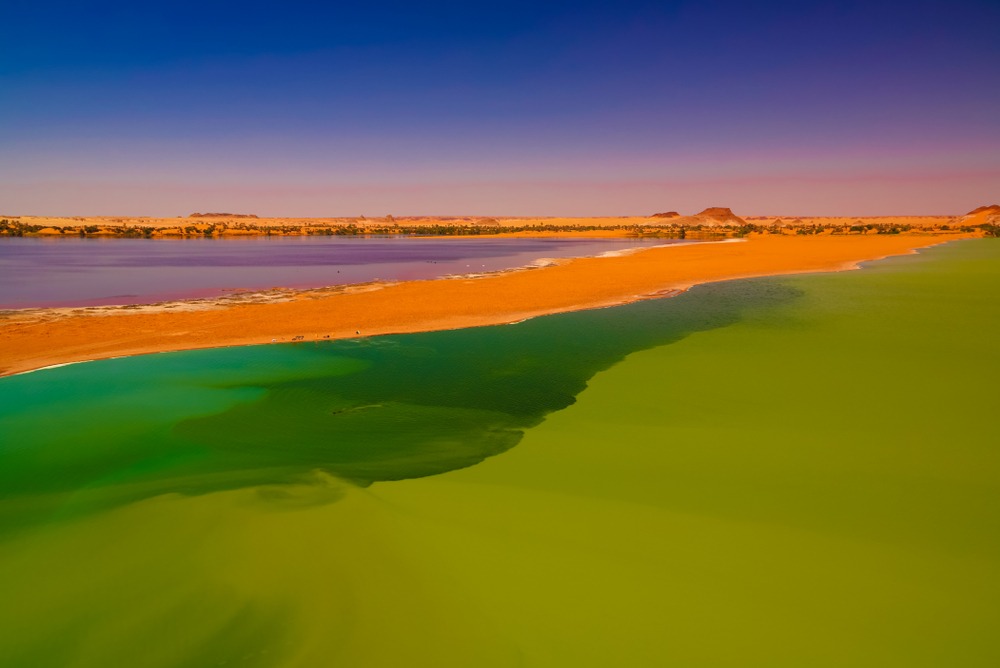
Trou au Natron
An 8-kilometre-wide caldera nestled in the Tibesti, the Trou au Natron brings together volcanic cones, active fumaroles and white salt deposits in one of Africa's most isolated landscapes.
The Trou au Natron is a volcanic caldera carved into the Tibesti massif in northern Tchad, at more than 2,000 metres above sea level. This crater, roughly 8 kilometres in diameter and about 1,000 metres deep, harbours secondary volcanic cones, active fumaroles and natron deposits—a white mineral salt that lines the floor. It stands among Africa's most spectacular and isolated volcanic landscapes.
What to see
From the caldera's rim, the gaze plunges across a floor dotted with black cones, white natron crystals and zones of yellow sulphur. Fumaroles still escape from certain fissures, evidence of residual geothermal activity. The interior walls, nearly vertical, descend for several hundred metres. A descent into the crater is technically demanding and reserved for properly equipped groups.
History and context
The Tibesti is one of Africa's largest volcanic massifs. The Trou au Natron resulted from the collapse of a magma chamber following an ancient eruption. Natron—hydrated sodium carbonate—deposits through the evaporation of mineral-laden waters. This salt was long known and exploited by the Toubou peoples of the Tibesti, who derived from it culinary and medicinal uses.
Highlights of the visit
The panorama from the rim
The view from the caldera's edge is striking: a sheer void, contrasting colours—volcanic black, mineral white, sulphurous yellow—and an almost complete silence. Morning and evening light accentuate the reliefs and hues.
The inner cones
At the crater floor, several secondary volcanic cones reach some hundred metres in height. Their regular shape and dark colour stand in sharp contrast to the pale natron deposits surrounding them.
The fumaroles
Discharges of vapour and gas are observed near certain fissures. They testify to geothermal activity still present and add a living dimension to this mineral landscape.
Photography tips
Low-angle light in early morning and late afternoon reveals the relief of the walls and the texture of natron deposits. From the rim, a wide-angle lens allows you to frame the entire crater. Dust and wind can affect optics: protect your equipment. A descent into the crater offers ground-level angles impossible from above, but requires proper gear.
Location and access
The Trou au Natron lies in the Tibesti massif, in the far north of Tchad, a region among the continent's most remote. Access is exclusively by 4x4 vehicle, from N'Djamena or Faya-Largeau, over unmarked tracks across the desert. The journey from Faya-Largeau represents several days of track. An experienced local guide and authorisation from Chadian authorities are essential. The region is subject to access restrictions related to security: inquire urgently before departure with your agency.
Nearby attractions
- Emi Koussi — Chad's and the Sahara's highest point, another volcanic caldera in the Tibesti, accessible by 4x4 from the same area.
- Faya-Largeau — northern Chad's main city, logistical departure point for any expedition into the Tibesti.
- Bardaï — a town in the Tibesti, forward base for expeditions towards the Trou au Natron and surrounding peaks.
Frequently asked questions
Yes. The Tibesti is a sensitive military zone. Authorisation from Chadian authorities is mandatory, and the visit must be conducted with an approved local guide. Your agency handles these formalities.
The cool season, from October to March, is most favourable. Temperatures at the crater floor and on the tracks remain manageable. In summer, Saharan heat makes conditions extreme.
Descent is possible but technically difficult, with very steep walls. It requires solid hiking equipment, good physical condition and accompaniment by an experienced guide. Most visitors are content with the rim.
Allow half a day to a full day to explore the rim and, if desired, attempt a partial descent. The approach journey from Bardaï represents several additional hours of track.
Large quantities of water, provisions for several days, warm clothing for nights at altitude, enhanced sun protection, sturdy hiking boots and bivouac kit. Resupply on site is non-existent.
No. The access tracks and terrain around the crater are highly rugged. The site is not developed and remains reserved for travellers in good physical condition.
Interested in this visit?
We can include it in your personalised itinerary.