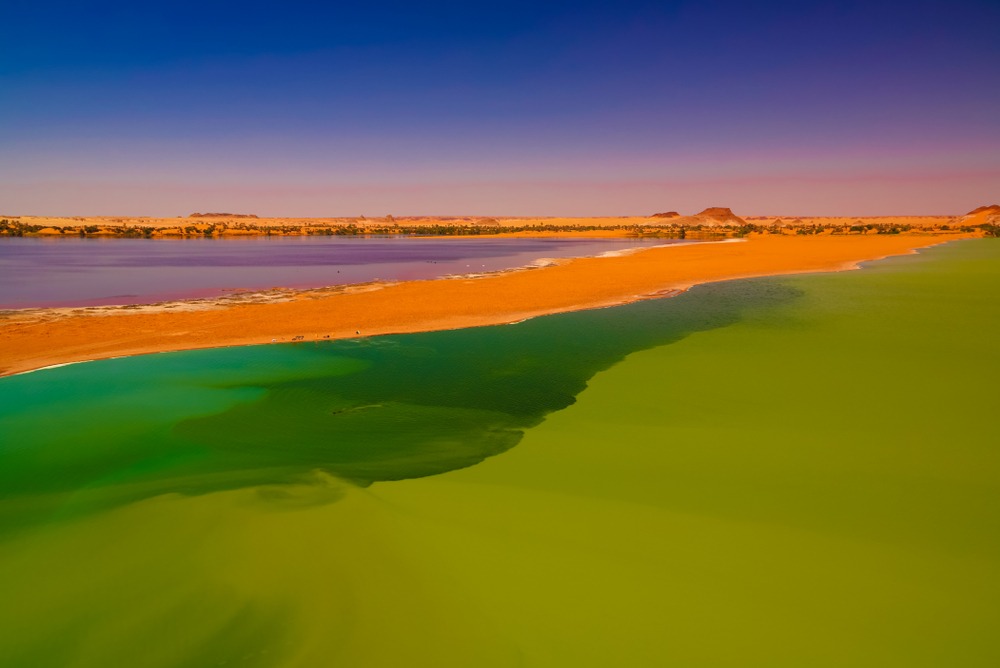
Sahara tchadien (Chad's Sahara)
Chad's Sahara brings together golden sand dunes, volcanic massifs and sandstone arches adorned with rock paintings. One of Africa's wildest deserts, spanning Tibesti, Borkou and Ennedi.
Chad's Sahara covers the northern third of the country, between the Tibesti massif to the west and Ennedi to the east. This desert of sand, rock and wind harbors landscapes of striking diversity: golden dunes, sculpted sandstone plateaus, isolated oases and rock engravings thousands of years old. It is one of the wildest and least visited portions of the African Sahara.
Quick facts
- Access: N'Djamena is the main gateway; domestic flights serve Faya-Largeau (Borkou), the departure point for Tibesti and Borkou.
- Dress code: Covering clothing is essential — sun and sand protection. A tagelmust or turban is strongly recommended.
- Recommended duration: Minimum 7 to 10 days for a meaningful circuit through Borkou or Ennedi.
- Season: October to March, with manageable temperatures. Avoid June to August (extreme heat, sometimes exceeding 45°C).
- Safety: Check your government's travel advisories before departure; some areas remain restricted.
- Accessibility: Not adapted for people with reduced mobility — sandy and rocky terrain, unmarked trails.
What to see
Chad's Sahara divides into several distinct regions. Tibesti lines volcanoes, including Emi Koussi, the highest point in the Sahara. Borkou unfolds vast dune fields and palm groves around Faya-Largeau. Ennedi, UNESCO World Heritage–listed, offers red sandstone arches and gorges adorned with rock paintings.
History and context
Chad's Sahara was crossed for centuries by caravan routes linking sub-Saharan Africa to the Mediterranean. Rock paintings and engravings in Ennedi bear witness to a wetter period, 5,000 to 10,000 years ago, when fauna and pastoral populations inhabited these now arid lands. Tibesti long remained the territory of the Toubou, a nomadic people renowned for their resistance to outside conquest.
Highlights of a visit
The Ennedi massif and its arches
Ennedi concentrates spectacular rock formations: the Aloba arch ranks among the world's largest natural arches. The gorges harbor gueltas — permanent waterholes — where desert crocodiles and baboon populations survive.
Rock paintings
Thousands of representations of animals, warriors and herds cover the walls of Ennedi and Tibesti. These frescoes constitute direct testimony to prehistoric Saharan civilizations, UNESCO-listed in 2016 (Ennedi massif).
Borkou's sand dunes
Around Faya-Largeau, fine sand dunes alternate with sebkhas (dried salt lakes) and palm groves. The raking morning and evening light transforms these landscapes into shades of ochre and red.
Emi Koussi (Tibesti)
An extinct volcano standing 3,415 m high, Emi Koussi is the highest point in the Sahara. Its crater, several kilometers across, is visible from the tracks that crisscross Tibesti — a zone whose access remains subject to strict security conditions.
Photography tips
The golden light of dawn and dusk is ideal on dunes and rock formations. Protect your equipment from sand with waterproof covers. For rock paintings, avoid flash — soft natural light better reveals the pigments. Always ask your local guides' permission before photographing residents.
Location and access
Chad's Sahara extends north of the 15th parallel, covering the Tibesti, Borkou and Ennedi regions. Faya-Largeau is the main stopover town, accessible by flight from N'Djamena. Travel on-site is exclusively by 4×4 with an experienced driver-guide. No paved road infrastructure serves the interior of the desert.
Booking a trip through a local specialized agency is strongly recommended for logistics, permits and safety.
Nearby
- Ennedi massif — UNESCO site, sandstone arches and rock paintings among the best preserved in the Sahara.
- Faya-Largeau — Main oasis in northern Chad, essential logistics hub for any Saharan circuit.
- Tibesti massif — Isolated volcanic chain, Toubou territory and setting for lunar landscapes.
- Lake Chad — To the southwest, evolving lacustrine ecosystem, crossroads of cultures and biodiversity.
Frequently asked questions
October to March, when temperatures are manageable, especially at night. Avoid June to August when heat can exceed 45°C in Borkou.
Yes. The lack of marked roads, security risks and need for administrative permits make an experienced guide and driver essential.
Tibesti access is subject to variable security restrictions. Check official advisories from your government and consult your local agency before any visit.
Yes, some two-week circuits link Faya-Largeau, Borkou and Ennedi. Distances are substantial and tracks demanding — plan for a minimum of ten days.
Light but covering clothes by day, warm layers for nights (cool in winter). A tagelmust protects from sun and sand. Sturdy closed-toe boots are essential.
Yes. Touching the walls is forbidden. Avoid using flash photography and follow your guide's instructions to preserve these UNESCO-listed artworks.
Interested in this visit?
We can include it in your personalised itinerary.