Ennedi
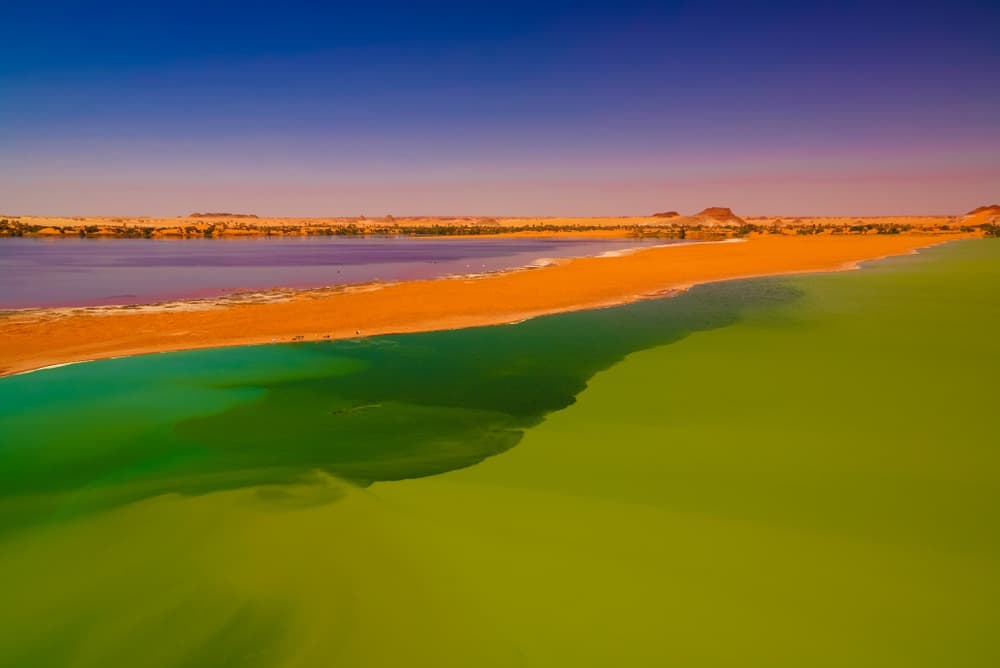
A 60,000 km² sandstone massif designated UNESCO World Heritage, Ennedi features 120-meter arches, crocodile-filled gueltas, and thousands of rock paintings around Fada.
Ennedi occupies the northeastern corner of Tchad, roughly 1,000 km from N'Djamena via desert track. It is a sandstone plateau spanning some sixty thousand square kilometers, rising to 1,450 meters at its highest point, cut at its margins by deep canyons. The massif was inscribed as UNESCO World Heritage in 2016 for its singular pairing of landscape and rock art. Our English-speaking agency based in N'Djamena organizes expeditions departing from Fada, the administrative capital of Borkou-Ennedi-Tibesti and the massif's only significant town, reachable by charter plane or after three to four days overland via Mao and Kalaït.
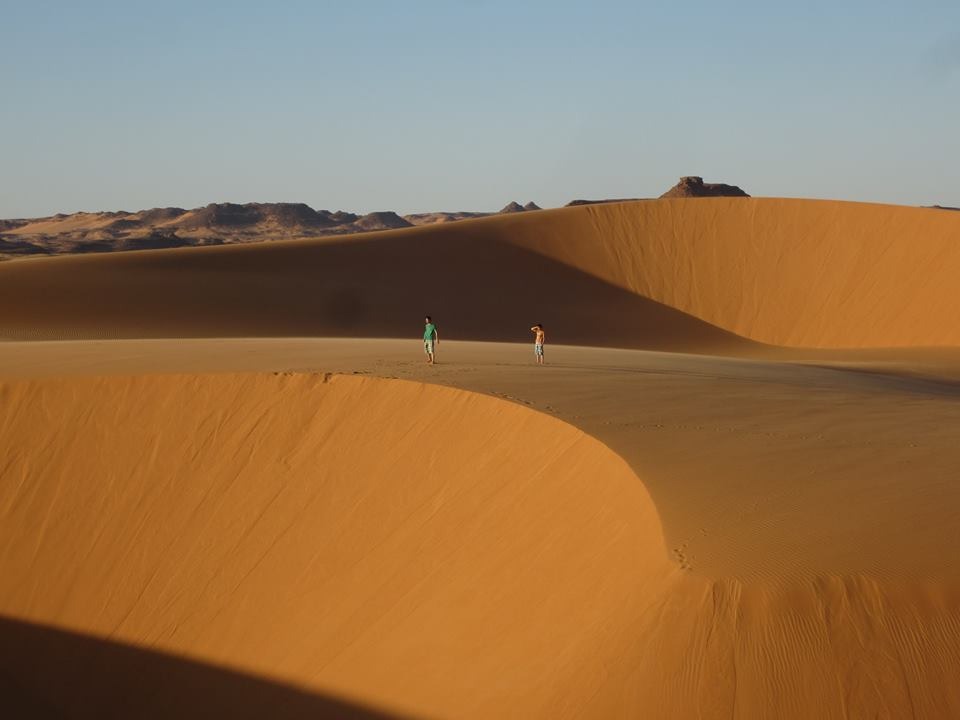
The geology here tells the story of a Sahara that once was humid. Soft sandstones, sculpted over millions of years by wind and ancient rains, have produced arches, needles, towers, and rocky labyrinths. The Aloba arch near Bachikele rises 120 meters with an opening spanning 77 meters, making it one of the world's largest formations of its kind. Further south, the Terkei sector features ochre cliffs and cirques navigated by 4x4 along sandy tracks that often require deflating tires for passage.
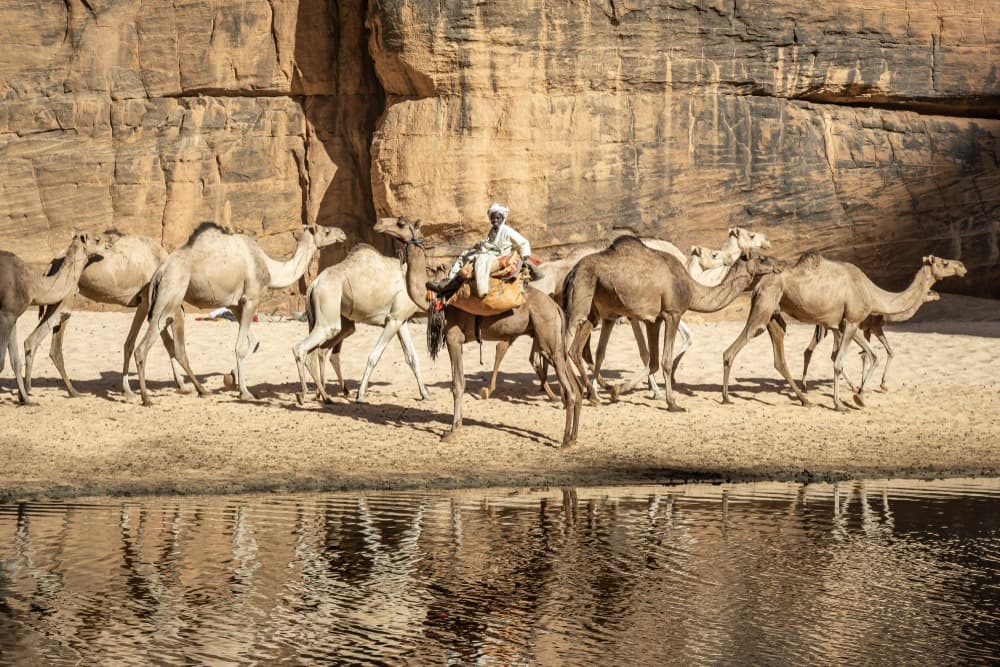
Gueltas—permanent water points nestled at the base of gorges—are Ennedi's ecological signature. The Archeï guelta, enclosed between 100-meter walls, shelters a small relict population of Nile crocodiles, the last Saharan survivors of a species that inhabited the entire region during the Holocene. In the mornings, Toubou herders bring their camels to drink, and the black water mirrors the ballet of livestock moving between rocks. The gueltas of Maya, Bachikele, and Koboué complete the hydrological network that structures all pastoral life here.
Rock shelters preserve several thousand paintings and engravings spanning nearly 7,000 years. At Manda Guéli, Niola Doa, Terkei Est, and Bichagara, one traces the transition from a verdant Sahara teeming with cattle to today's desert: large herds rendered in ochre, adorned human figures, then camels from the final millennia. These panels are discovered without museological mediation, at eye level, sometimes after a brief walk through sand.
Ennedi's inhabitants are predominantly Toubou Gorane and Arab Zaghawa, organized around camel pastoralism and small palm groves in Fada, Ouounianga, and Bao. Camps are erected on mats, tea is served in three rounds, and evening meals often center on marag—a goat ragout—or millet balls with okra sauce. Our Toubou guides, recruited in Fada, read invisible trails and negotiate passage through grazed gueltas with campement chiefs.
The local economy rests on pastoralism, caravan trade that persists between Fada and Libya, and artisanal salt extraction at Demi. Tourism remains nascent: we conduct a few dozen visitors per season, never in tight groups. This low density, combined with landscape quality and archaeological richness, distinguishes Ennedi from busier major Saharan massifs like Hoggar or Tassili.
To discover
The Aloba arch at 120 meters. An hour's walk from base camp to the foot of the formation, its ogival opening revealing itself suddenly at a ridge's turn. Sunset colors the sandstone deep red around 6 p.m.
Archeï guelta at dawn. A descent on foot through a tight canyon to observe Toubou herders' camels drinking and occasionally glimpse crocodiles in pools of black water.
Rock paintings at Terkei and Manda Guéli. Several decorated shelters at eye level, where one follows the succession of bovine, equine, then camelid periods across more than 5,000 years of human occupation.
Bivouac in the Bichagara labyrinth. A night under canvas or beneath the stars among sandstone needles, where January's cool drops to 12 or 15°C after daytime highs of 28°C.
Fada's weekly market. Exchanges between Toubou herders and merchants from Kalaït and Abéché, where Faya dates, Demi salt, and Libyan textiles circulate.
When to visit
The visiting season opens in late October and closes in early March. In January, peak season, expect 15 to 18°C at night in the massif and 25 to 30°C by day, with consistently clear skies. November and December offer the most stable conditions; February brings the harmattan, a sand-laden wind that can veil the landscape for two to four days straight.
From mid-March onward, temperatures climb rapidly: 35°C by late March, reaching 42 to 45°C in May-June, rendering walks and bivouacs arduous. The rainy season, July through September, brings occasional violent storms that may render certain wadis impassable for 24 to 48 hours and severely complicate logistics. We do not organize massif circuits between April and October.
Practical advice
Plan a minimum of 8 days at Ennedi, with 5 to 6 full days in the massif. With air rotations N'Djamena-Fada by charter plane, which saves six to seven days of overland travel, a 10-day itinerary allows visiting Fada, Archeï, Aloba, Bichagara, and Terkei without rush. Overland, allow 14 to 16 days minimum. Logistics depend on convoys of at least two Toyota Land Cruisers for mechanical safety, carrying water, fuel, and provisions for the entire duration.
Ennedi pairs well with Tibesti for experienced travelers with three weeks, or with Lake Tchad and Kanem for contrasting desert pastoralism with lacustrine fishing on a single circuit. Comfort is that of bivouac: igloo tents, foam mattresses, meals prepared by our cook, occasional solar showers. This region suits contemplative travelers, moderate walkers, geology and archaeology enthusiasts, and those captivated by star-filled nights. It does not suit families with young children or travelers seeking marked trails and infrastructure.