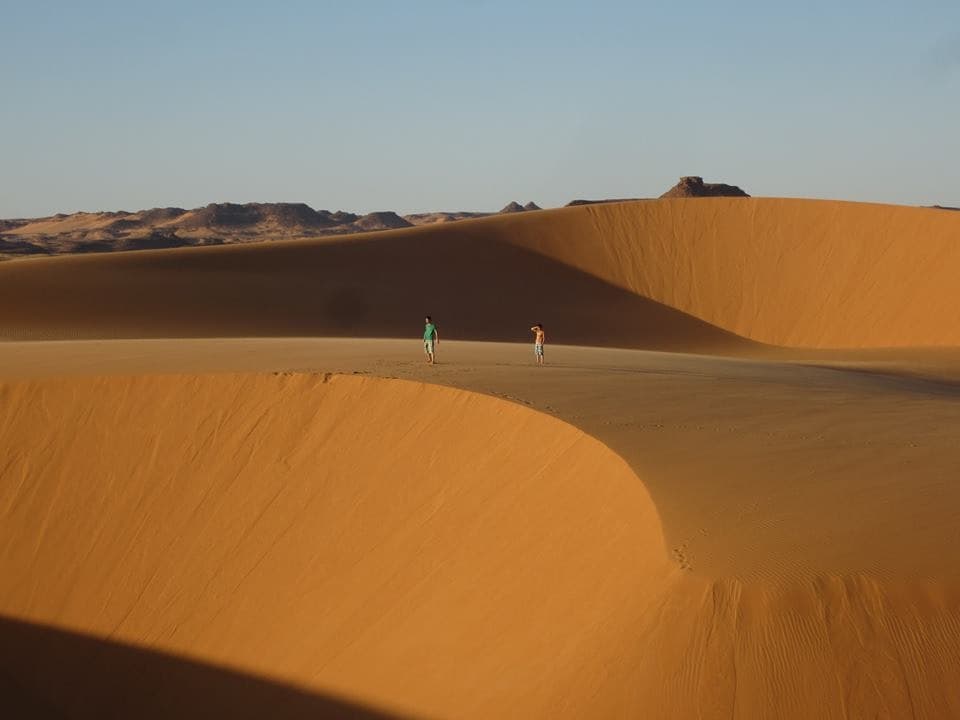
Faya
Faya
An isolated oasis town nestled deep within Chad's Sahara, Faya Largeau is the gateway to Tibesti and Ennedi: a 70 km palm grove, tassilis, and rock art.
Its name carries colonial echoes. Faya Largeau inherited its name from French colonel Étienne Largeau. This isolated oasis town, cradled in a depression amid the Saharan desert of Chad in the north of the country—yet remaining the region's largest city—has seen little progress in recent decades. Beyond the geological formations surrounding it, there are few attractions save for its remarkable 70 km-long palm grove.
History of Faya Largeau
Before the French renamed it "Largeau" in honour of Colonel Étienne Largeau, who took possession of it in 1931, the city was originally called Faya. Following Chad's independence in 1960, it was granted the name Faya Largeau.
During the Chadian-Libyan territorial war over control of the Aouzou Strip, Faya Largeau faced Libyan military forces who conquered it in 1975. Hissène Habré's forces managed to liberate the city in 1980, but barely three years later, Libya seized it again. Muammar Gaddafi's forces established an air base there, which was destroyed by French bombing as part of Operation Épervier in Chad. In 1987, the Chadian army launched an offensive in the region, forcing Libya to withdraw permanently. French military support played a crucial role in restoring peace to the Faya Largeau area.
Over the past century, Faya Largeau has been the subject of numerous development attempts focused on rationalizing the exploitation of local resources. Various external entities participated, initiating constructions and technical training programs that were largely abandoned after a few decades. These failures reflect a particular interpretation of time and progress in Faya Largeau, rooted in the local desire for autonomy.
Faya Largeau Today
Above all, it is an oasis town at the heart of the desert and the capital of the Borkou-Ennedi-Tibesti region. Located 790 km northeast of N'Djamena, Faya Largeau portrays an image of a land forgotten by the world and by the Chadians themselves. Fortunately, its subsoil contains relatively abundant water resources, enabling agricultural activity—dates represent the primary crop here. Approximately 65,000 people live here, under the watchful eye of French armed forces since 1986. Traditions have remained largely unchanged, save for the camel giving way too often to the pickup truck and the machete replaced at some point by the rifle.
Faya Largeau is a stop on the Saharan circuit through Chad. Remarkably, the town possesses an airport, admittedly rarely frequented by civil aircraft, yet still capable of welcoming tourist groups. The adventure truly begins the moment the plane touches down. Transfer from the airport is made not by vehicle, but rather by camels serving as pack animals. From the airport, you trek toward the palm grove where you can refresh yourself before diving into the heart of the desert landscape.
At the city's periphery, tassilis emerge on either side. Wind erosion across the Sahara has carved into the sandstone reliefs, shaping singular geological features. North of Faya Largeau, the Archana tassilis mingle with dunes and harbour rock paintings. Elsewhere, other treasures await discovery, notably the great Ariminga rock, which served as a strategic point for Chadian resistance led by Hissène Habré. The Ounianga lakes are also well worth visiting.
Faya Largeau, Gateway to the Tibesti Massif
Faya Largeau is an excellent starting point—indeed, an essential stop—for trekking in the Tibesti massif. As you leave the town, jagged horizons emerge against tortured landscapes. You're now entering the territory of the Toubou, nomadic peoples of central Sahara who have found refuge in the volcanic mountains of the desert. The ultimate challenge? The ascent of Emi Koussi, the highest peak in the Sahara, standing at 3,415 metres above sea level.
Climate
Faya Largeau inherits the harsh meteorological conditions of the Borkou region, at the heart of the Sahara's hyperarid zone. Intensely pronounced, its hot desert climate, classified as BWh on the Köppen-Geiger scale, is characterized by a very long and scorching summer. The hot season at Faya Largeau typically extends from April through September, with average maximum temperatures exceeding 30°C—these can approach 45°C in June. During the rest of the year, temperatures rarely fall below 20°C. It remains hot even during the supposedly cooler months of December and January, when highs hover around 28°C. As for rainfall, Faya Largeau records an average precipitation of 16 mm annually, falling only between June and September—the town may receive no rain at all. Sunshine duration averages 300 hours per month and 4,000 hours per year.
In summary, Faya Largeau sits in one of the world's hottest, driest, most arid, and sunniest regions.
Few transport options serve the town. Forget about buses; if you wish to come to Faya Largeau, you'll need to arrange a rental car, ideally a 4x4 with a local driver. Isolated among the dunes, the Faya airstrip is rarely used by tourists. The asphalt runway is primarily used by the French military.
The small Faya Largeau airport, though infrequently used, handles flights to and from the capital N'Djamena and Abéché.
At Faya Largeau, prepare yourself with good footwear as you'll be doing considerable walking. Camels are available to carry heavy loads.
What to Do at Faya Largeau?
- Traverse the Faya Largeau palm grove
- Search for rock paintings hidden within the Archana tassilis
- Ride camels across the surrounding dunes
- Prepare your trek into the Tibesti massif
- Visit the Ounianga lakes, and more
Want to discover this destination?
Our local advisors design your tailor-made trip.