Guelta d'Archei
Guelta d'Archei
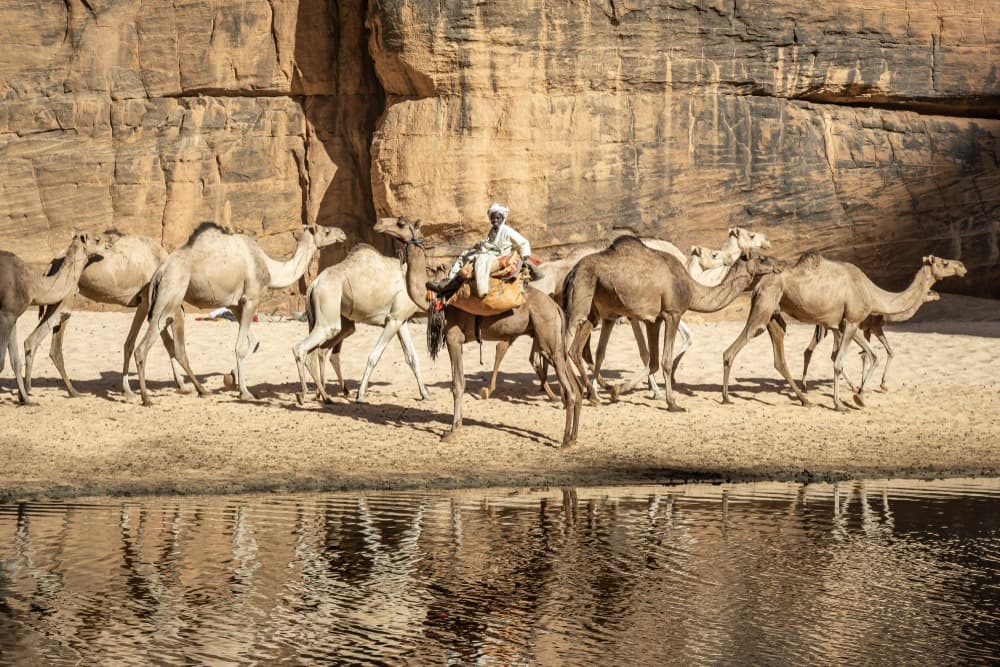
A permanent basin at the heart of the Ennedi plateau, Guelta d'Archei is home to the last West African crocodiles of the Sahara and remains a waypoint for Toubou caravans.
Guelta d'Archei is a permanent water basin nestled at the foot of a canyon in the Ennedi plateau, in northeastern Chad. Located approximately 40 km southeast of Fada, this pocket of water is home to one of the last populations of West African crocodiles in the Sahara and has served for centuries as a waypoint for Toubou camel caravans.
Why visit Guelta d'Archei
The site combines several characteristics that are rare on the Saharan scale. First, it is a biological refuge: a few dozen West African crocodiles (Crocodylus suchus), also called desert crocodiles, survive here while the species became extinct across almost the entire Sahara in the early twentieth century, due to both the drying up of water points and poaching. These crocodiles rarely exceed 2.5 meters in length, considerably smaller than their Nile cousins.
It is also an actively living pastoral place. Toubou caravans water their dromedaries here, women fill guerbas, these traditional leather gourds made from goat skin, and the canyon echoes with the bleating of animals several hours a day. Finally, the site is part of the cultural and natural landscape of the Ennedi, inscribed as a UNESCO World Heritage Site since 2016.
History and formation of the site
Gueltas are pockets of water typical of Saharan massifs: in rocky depressions, groundwater rises to the surface and forms semi-permanent basins. Four springs feed Archei, which explains its permanence even during the dry season. The dark color and brackish smell of the water come from centuries of accumulated camel droppings: these deposits fertilize the basin, promote algae proliferation, which feed the fish, themselves prey for crocodiles. The entire ecosystem relies on this cycle.
The exact origin of the place name "Archei" remains debated; it is sometimes translated as "desolate land," but this Arabic etymology should be taken with caution, as the word likely stems from a local language. A Toubou legend holds that the waters will never dry up as long as crocodiles live in them—a belief that likely contributed to the de facto protection of these reptiles over generations.
At the canyon entrance, beneath the acacias, Holocene rock paintings adorn the walls: one can distinguish dromedaries, horses, and small human figures, witnesses to ancient human occupation of the massif.
What to see and do
Observe the crocodiles
Crocodiles spend most of the day on the banks, basking in the sun, and dive at the slightest suspicious movement. Accustomed to a diet of fish, they rarely attack dromedaries or humans. To observe them without disturbing the caravans, it is advisable to reach the rocky promontories overlooking the guelta: the bird's-eye view of the basin allows you to take in both the reptiles, the herds, and the canyon. There are no marked trails, but access to the heights remains accessible.
Walk through the canyon
In January-February, the water level is sufficient to walk up the canyon with your feet in the water, reaching clear pools ideal for swimming, downstream from the crocodile pools. During the rainy season (July-September), small waterfalls spill from the cliffs; the pools then gradually shrink until they become mere remnants by May-June.
See the rock paintings
The Holocene frescoes at the canyon entrance are a brief but memorable stop. A local guide will point you toward the most legible panels.
When to go
The best period spans March to May: temperatures are still bearable, tracks are passable, and water levels permit both crocodile observation and canyon walks. From June to September, the heat becomes extreme and rains may make some tracks difficult. From November to February, desert nights are cool but days are pleasant; January-February offer the advantage of a water-filled canyon.
How to get there
Access is mandatory by 4x4 convoy from N'Djamena. Plan for approximately four days of off-road driving across the desert to reach the Ennedi, then a few hours' walk from the base camp to the basin. Travel by dromedary is possible on short sections, but the entire journey from the capital is by vehicle. Fada, approximately 40 km to the northwest, serves as the administrative rallying point.
The journey is systematically organized with a local agency, for logistical reasons (fuel, water, permits) and safety.
Practical information
- Location: ~40 km southeast of Fada, Ennedi plateau, northeastern Chad
- Access: 4x4 mandatory, guided expedition
- Entrance fee: modest, collected by the local committee
- Management: a local committee founded by women's groups administers the site; revenues finance bivouacs, evening activities, and meals, and benefit the Toubou population
- To bring: ample water, sun protection, hiking shoes, protective clothing
Nearby attractions
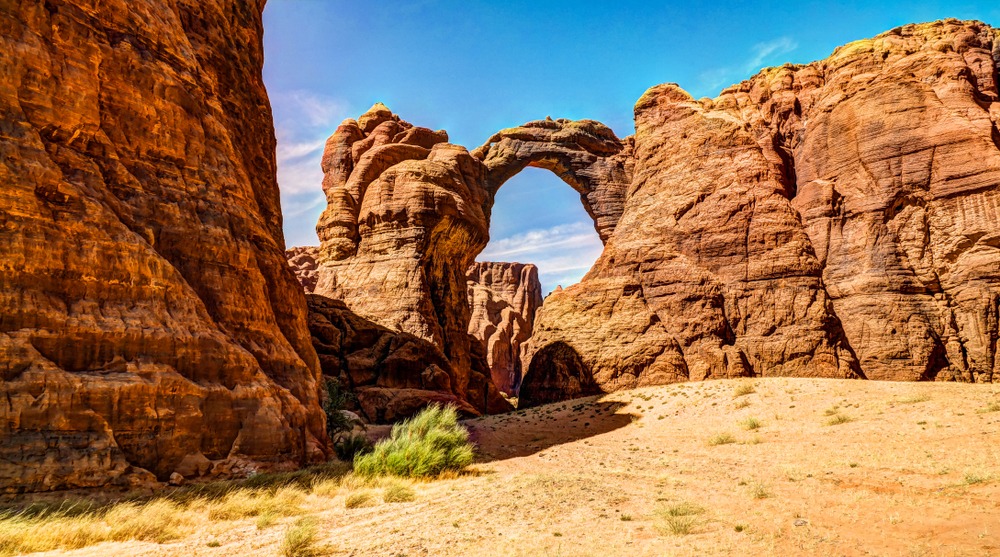
The guelta is part of the larger Ennedi plateau, whose sandstone arches, rocky peaks, and shelters adorned with rock paintings merit several days of exploration. Further north, the Ounianga lakes, also UNESCO-listed, form a string of permanent bodies of water in the heart of the Sahara. To the south, Emi Koussi, the highest point in the Sahara, logically rounds out a northern Chad circuit.
FAQ
Frequently asked questions
No, in practice. These West African crocodiles, smaller than those of the Nile (rarely more than 2.5 m), feed primarily on fish and almost never attack the dromedaries or humans who have frequented the basin for generations. It remains prudent to maintain a reasonable distance and follow the guides' instructions.
March to May for an ideal balance between temperatures, accessibility, and water level. January-February allows you to walk through the canyon with your feet in the water. Summer (June-September) should be avoided due to extreme heat and rains.
Only via an organized expedition: approximately four days of 4x4 driving across the desert to the Ennedi plateau, then a few hours' walk from the bivouac to the basin. Working with a local agency is essential.
Plan your trip
Guelta d'Archei is best discovered as part of a complete expedition on the Ennedi plateau. To build a custom and secure itinerary, consult our suggestions for travel to Chad.
Interested in this visit?
We can include it in your personalised itinerary.